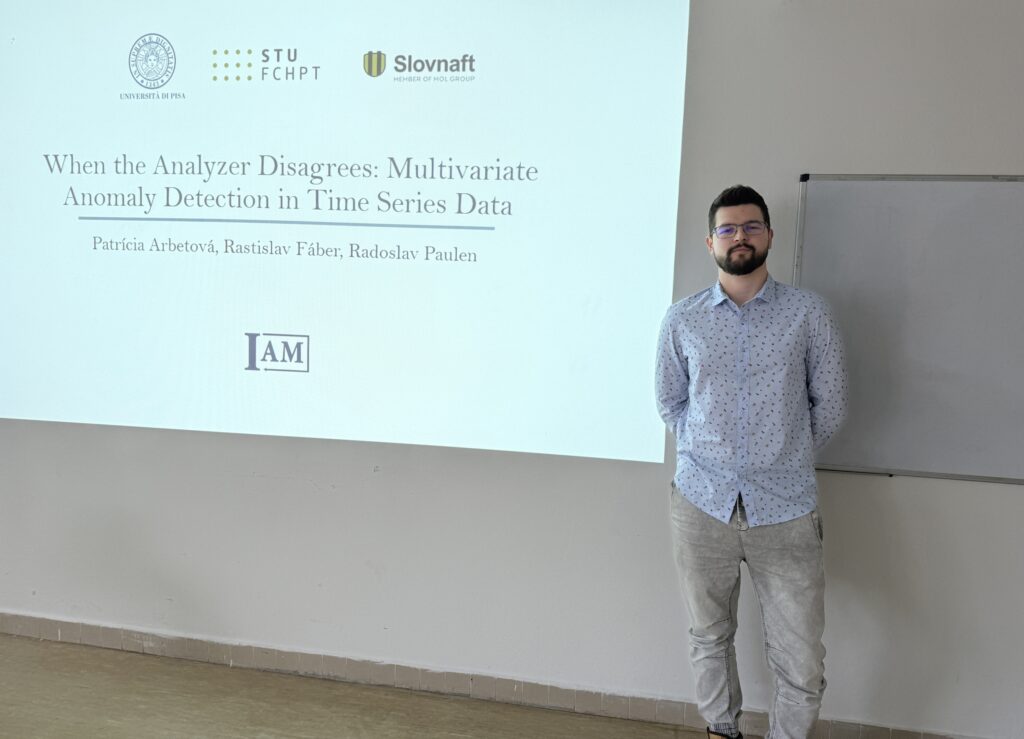
On December 12, we organized a scientific seminar titled “When the Analyzer Disagrees: Multivariate Anomaly Detection in Time Series Data”. Rastislav Fáber, a PhD student at the Slovak University of Technology in Bratislava, led the seminar, which was organized within the framework of the FrontSeat project as part of the “Research Seminar on Smart Cybernetics” series.
Abstract:
The talk looks at anomaly detection in multivariate time series from an industrial alkylation unit. We start from a previously developed multi-fidelity soft sensor that combines dense analyzer data with sparse laboratory samples to estimate the lab-quality trend of a key composition variable. This prediction is used only as a reference: we label anomalies on the analyzer signal when it deviates from the soft-sensor trend beyond a defined threshold. On this labelled dataset, we compare three variations of detectors: (i) simple rules on the output (difference thresholds, EWMA, Western Electric rules), (ii) input-space methods based on feature selection, PCA/PLS, clustering, and Isolation
Forest, and (iii) model-based detectors that use OLS and Gaussian process models. The talk shows how these approaches trade off sensitivity and false alarms on real refinery data and discusses which combinations are most practical for day-to-day monitoring.
This project has received funding from the European Union’s Horizon under grant no. 101079342 (Fostering Opportunities Towards Slovak Excellence in Advanced Control for Smart Industries).




0 Comments